



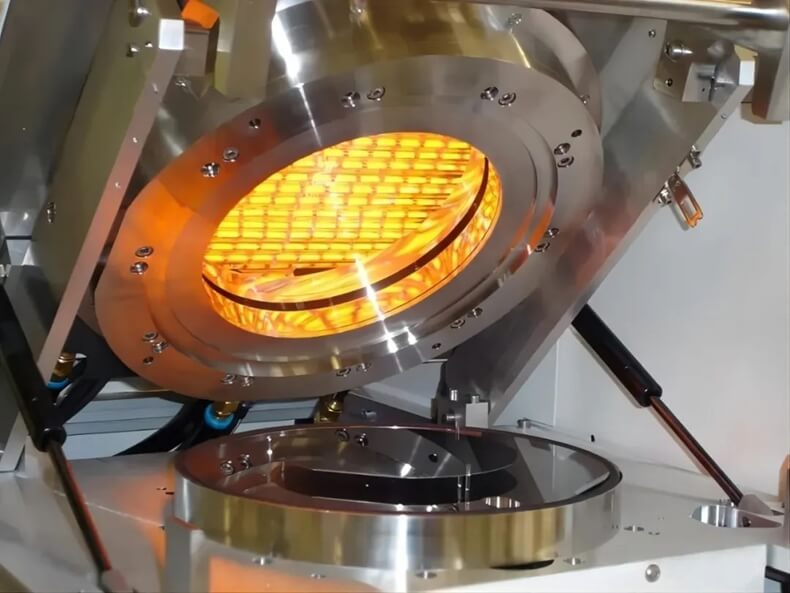
Out on the lithography floor, the soft bake isn’t some casual warm-up. It locks in the solvent profile, shapes the CD budget, and sets the line-edge roughness you’ll live with for the rest of the day. Let the hotplate drift by ±2°C and the dose window shrinks—fast. Rejects pile up. We built a medium wave infrared heater for wafer processing to cut that variability out of the equation. What matters, technically Medium wave IR heats the photoresist stack volumetrically, not just the surface. You get a faster thermal ramp with less lag. We hold wafer-level uniformity within ±0.1°C across the active area, and repeatability within ±0.05°C run-to-run. The emitter array sits behind a sealed quartz envelope—no open coils to outgas or shed particles. The heater body is cleanroom-compatible for Class 1–100, and every surface is passivated so particle counts stay flat, even on 24/7 runs. Temperature control closes the loop at the wafer plane, not back at the heater block. Why it works in practice In a photoresist bake, you need the solvent stripped quickly and evenly, then a stable bake that holds setpoint while the chuck is moving. Our medium wave system hits setpoint in seconds and stays there, so every wafer sees the same thermal history. The payoff is tighter CD control, fewer rework lots, and higher throughput without chasing temperature offsets. You also save energy, because the emitters focus heat where it’s needed, and the low thermal mass cuts standby losses. A few practical notes Medium wave is tuned for organic films on silicon, but it’s sensitive to emissivity differences on metal or thick dielectric stacks. Plan on a short qualification run to set the recipe and confirm the thermal stack. Installation needs a clean power feed and a rock-solid mechanical interface to the wafer chuck—sub-millimeter misalignment can tilt the uniformity map. Once it’s aligned, the system runs with minimal maintenance. When replacements are due, you schedule them. You don’t get paged in the middle of the night.